









I started my career in 2009. AK Ops became a company in 2017. I’ve watched founders raise money on a single slide that says “if we capture 1% of our TAM, we’re a billion-dollar company.” I’ve watched boards approve headcount before they ever asked whether the reps they’re hiring can actually get someone on the phone. And I’ve watched more “growth strategies” collapse under their own weight than I can count, because they were built on a mindset that stopped working a long time ago and nobody bothered to update the model.
The part we’ve always understood differently is that getting the right human in front of the right human, at scale, takes a tech/AI-enabled engine behind it. That’s been our MO since day one: not replacing the relationship, building the machine that makes more of the right ones possible.
For the last eight years, I’ve worked this closely with roughly 25 client teams a month. That’s given me a look at what’s actually good and actually bad in this industry that most people never get, because I’m not reading their case study. I’m in the room. I know these leaders’ stress, their real plans versus the ones in the board deck, their tactics, the emotions underneath the numbers they’re presenting upstream. And what we bring them, every time, isn’t a vibe or a vision board. It’s a math-based plan they can actually believe in, because it’s been built and rebuilt against real accounts, real cycles, real people.
So here’s my take on what truly works in 2026: it was never about the big event, the perfect quarter, or the campaign everyone worked on for a month. It’s about the plays you’ve locked in for a segment of a segment because you know it books. It’s about compounding signals that actually indicate dial-worthy activity. The truth is most people are campaign-oriented, not engine builders monitoring the pulse of their own levers every day and making small week-over-week changes to capitalize on everything available to them. Most aren’t conversion-oriented at all.
Here’s what I’d actually tell you if you’re a revenue-responsible professional coming out of H1 2026: six pieces of feedback, no sugarcoating, based on what I’ve watched work and fail in real accounts this year.
Who, specifically: before how many
“1% of TAM” thinking isn’t ambition. It’s a way of avoiding the actual question, which is: where are your next 100 customers coming from?
Not your next market. Not your next category. Your next 100 customers, specifically, by name, by signal, by reason they’re ready now instead of theoretically someday. If your growth plan starts with a market-size slide instead of a person, you haven’t built a strategy. You’ve built a hope with a spreadsheet attached.
Before you can win them, you have to actually know them, not “know their title,” know them. What’s keeping them up, and is it the thing they’ll admit to you or the thing underneath it? What are they reading this week, not a persona doc from eighteen months ago? Where do they go when they have a real problem and no idea who to trust: a Slack community, a specific analyst, a peer they text before they text anyone on your team? Whose opinion actually moves them: a competitor’s customer, an investor, someone they follow who’s never sold them anything? That’s the intimacy that turns a list into a segment. Everything else is just a database with good intentions.
That shift changes everything downstream. It’s the difference between hiring a room full of dialers and building a handful of tightly run motions that actually produce pipeline. It’s the difference between a sales team that’s expensive because it’s large, and a sales team that’s efficient because it’s precise. Gone are the days you need to hire your way into revenue. If you’re still solving pipeline problems with headcount, you’re solving a 2015 problem with a 2015 answer.
Nobody shows you the bowl of spaghetti of what it takes to actually “go to market”
Every company can put together a clean two-slide version of “how we go to market.” Marketing does this, sales does that, here’s the funnel, thanks for coming.
That’s not what good looks like. That’s the highlight reel.
The real version (the one nobody wants to put in a deck because it looks like chaos) is a tangled, constantly-tended system: founder and executive visibility on LinkedIn, layered channel intercepts, a foundation (deliverability, data health, list hygiene) that has to stay clean every single day or the rest of it falls apart, and a database that’s being nurtured and prospected simultaneously instead of split in half between “marketing people” and “sales people.”
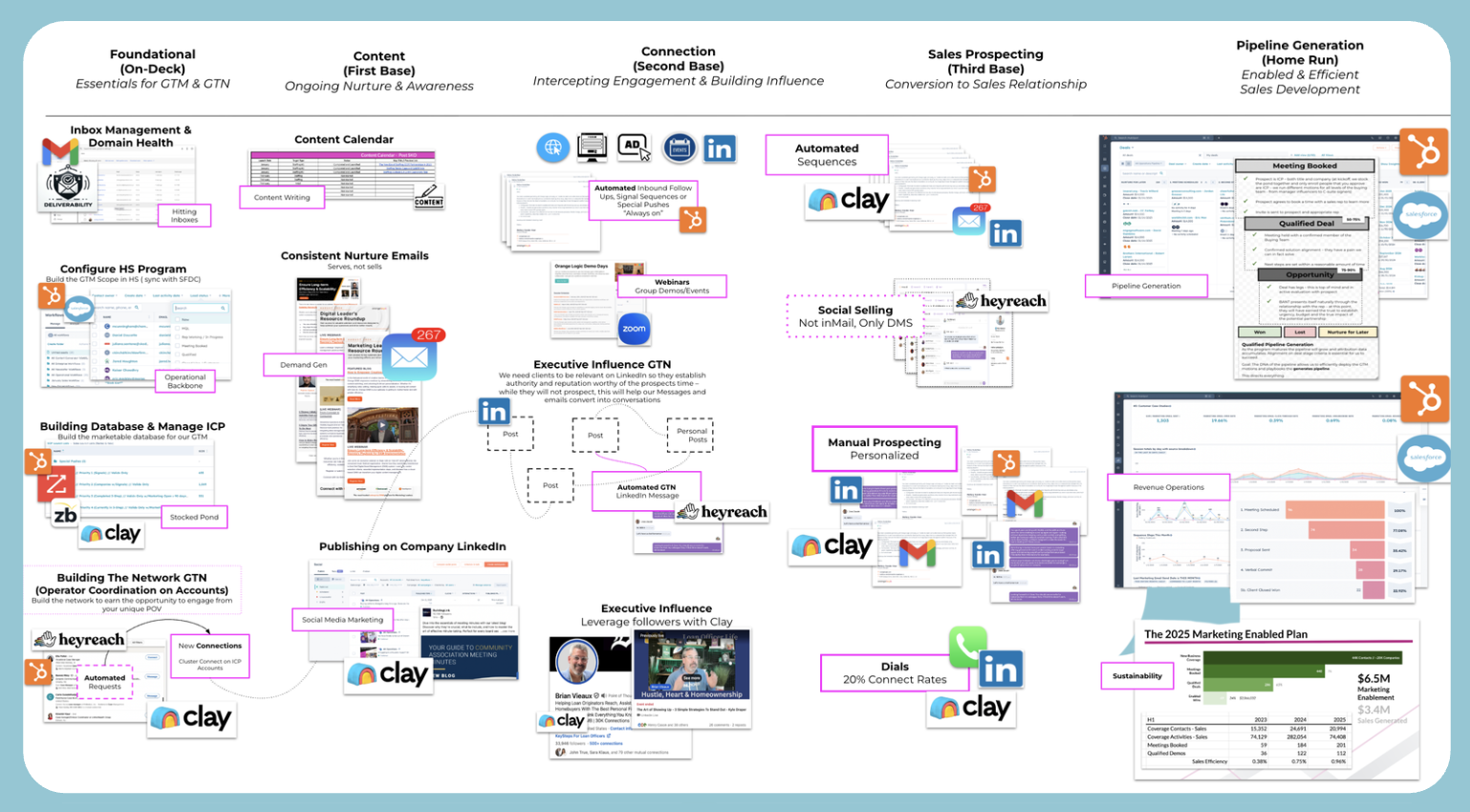
And that mess isn’t optional overhead. It’s a direct response to how buyers actually behave. Nobody moves in a straight line anymore. A buyer reads a piece of content in March, goes quiet for two months, resurfaces as an event attendee in May, ghosts again, shows up liking a founder’s LinkedIn post in July, and doesn’t raise their hand until a trigger event finally makes the timing right. Along the way they touch five, six, seven different channels, in no particular order, at no predictable pace, and most of it happens where you can’t see it: dark social, a colleagues forward, a conversation that never touched your database at all.
That’s the part most GTM plans get wrong. They’re built like a funnel: top, middle, bottom, clean handoff, when the buyer’s actual path looks more like a scatter plot that only makes sense in hindsight. The sophistication isn’t in predicting the path. It’s in building a system with enough surface area that you catch the buyer wherever they resurface, and enough memory that when they do, you recognize it instead of treating it like day one. Getting someone to genuinely enter your pipeline (not a form fill, not a sales-accepted checkbox, but real intent) takes far more coordinated tending than most people are willing to admit. Getting them to become a customer, and then a repeat one, takes multiples more.
That mess is the point. If your GTM motion looks simple from the outside, either you’re lying to yourself about how much maintenance it actually takes, or you’re not doing enough of it. Good is not clean. Good is disciplined chaos that’s being managed on purpose, every day, by people who understand every wire in the system, not a campaign calendar that gets dusted off once a quarter.
Campaigns end. Engines don’t.
This is the actual line I want to draw for 2026: a campaign is something you run. An engine is something you build.
Campaigns have a start date and an end date. They spike and they die. An engine compounds: every signal you collect makes the next one more accurate, every response teaches you something about what to do differently next time, and none of it turns off between initiatives.
Here’s a real example. We track “compounding signals,” not just whether someone opened an email or hit a webpage once, but what happens when multiple signals stack on the same contact. When a former event attendee shows up again as a content reader during an active buying window, that’s not a coincidence, that’s a pattern worth escalating: three call tasks instead of one, moved into a higher-priority sequence, treated like the warm signal it actually is. Clients running this well are seeing signal clusters make up nearly a third of their booked meetings. That’s not a campaign win. That’s an engine doing its job.
But consider the breadth of skill it actually takes to read that play correctly. You’re not just glancing at one metric, you’re triangulating lead source, event engagement, signal collection on marketing emails that excludes bot activity, web traffic that excludes bot activity, clustered activity across the whole company in the engine, confirmation that the individual actually meets ICP criteria, and data that’s been updated and validated recently enough to trust. Miss any one of those and you’re not reading a signal, you’re reading noise that happened to look like one.
The EBITDA conversation is nonstop.
Every senior leader eventually goes to their board and asks about hiring more reps or a growth team. And the board asks the only question that matters: what does this do to EBITDA?
Full-time headcount (salary, commission, hardware, ramp time, management overhead) is never a small yes. A fractional, signal-led motion that covers its own cost in the first few months (and then some) barely registers against that same expense line. That’s not a sales pitch, that’s math. If you’re not stress-testing your growth spend against EBITDA before you commit to it, you’re not being strategic, you’re being reactive with a bigger budget.
Imagine having the answer to “will it work” before you hire anyone, before you invest in a single expensive channel. With the right partner, you get the full gamut: cold calling, social prospecting, social influence, outbound, events, inbound, all of it running together. Clients who partner with us to learn and run these plays can build out that muscle, data and all, in under six months. From there they either graduate the motion in-house as full-time hires, or they stay put and we double down on what’s already working.
LinkedIn can’t be pay-to-play. It’s earned and needs to be genuine, and it’s slow on purpose.
The same discipline that applies to email applies to every channel, including the one most people still treat as an afterthought. You don’t blast connection requests and hope. You nurture the network you’ve already earned, contribute content that means something to the people already there, and let the algorithm do exactly what it’s built to do, which is reward genuine engagement over volume.
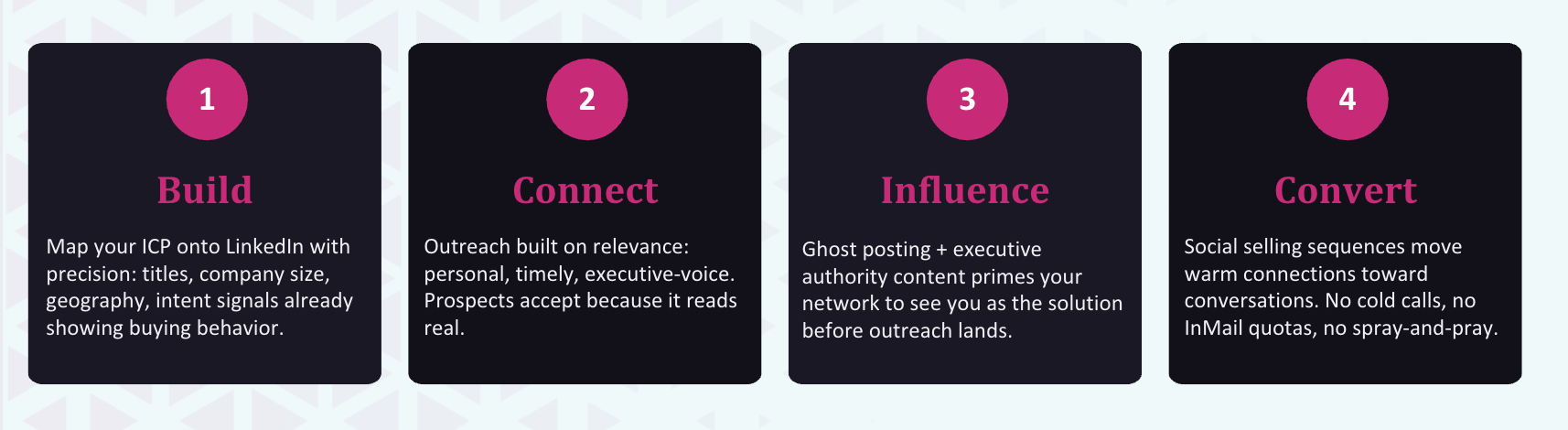
New connections see your content at roughly 10 times the rate of people you’ve been connected to for years. That’s not a hack. That’s the platform telling you it wants relationships that are actually being built, not harvested. Ghost-posting done right isn’t a corner you cut when you have time. It’s a real, patient investment in executive authority that pays off exactly like every other channel: slowly, then all at once.
A marketing engine is always on, and produces consistent pipeline.
Here’s our part people skip: real ROI conversations happen before the partnership starts. If the math doesn’t work (if the cycle time is too long, if the expectations don’t match reality), the right answer is to say so upfront, not to sign the client and manage the disappointment later.
But even when the math is right, the model breaks if the alignment isn’t real. You can’t bogart the inbounds and isolate one play as “theirs” when the engine runs against all of it in the background. The engine doesn’t work that way, and it was never designed to. It’s reading every signal, nurturing every company, pushing resources to every segment that’s showing intent, no matter who owns the account or the contact. At the end of the day, an engine doesn’t get compensated for booking the meeting. The rep does. He may make a lower percentage on enabled deals, but he’ll have higher win rates and more deals to work. That trade is the whole point.
Some deals close almost entirely on automation: no human hand on them until the deal itself. But most don’t. The best-performing teams aren’t the ones arguing over who touched what last. They’re the ones who agree, in plain language, on three categories:
- What pipeline is directly generated by the engine
- What deals were influenced by the engine
- What’s truly self-sourced, with zero help from marketing
That’s not a reporting nuance. It’s close to a cultural agreement. Once everyone actually understands and believes those definitions, the credit conversation stops being a fight and starts being a profitable roadmap to the greatest team sport of all time.
What 2026 actually requires
Stronger reps with an engine will outperform a bigger team running old plays, every time. Good in 2026 doesn’t look like more headcount, more campaigns, or a cleaner slide. It looks like a system that never stops learning about itself: signals compounding on signals, channels reinforcing each other, and the discipline to keep the whole thing running even when nobody’s watching.
You don’t get to 2026-good by launching something great. You get there by never letting it stop. That’s the whole difference: campaigns chase a moment. An engine builds a company. This isn’t a playbook you run once a quarter. It’s the standard you hold every single day. That’s what good actually looks like in 2026.