








Client: vQuip — Adventure Insurance for Powersports, Watersports & Outdoor Enthusiasts
Period: April 2025
vQuip operates in a niche but fast-moving market: specialty insurance for adventure and outdoor recreation. To grow, they needed a consistent, scalable pipeline, one that could convert cold outreach into qualified meetings without relying on a large sales team or spray-and-pray email volume.
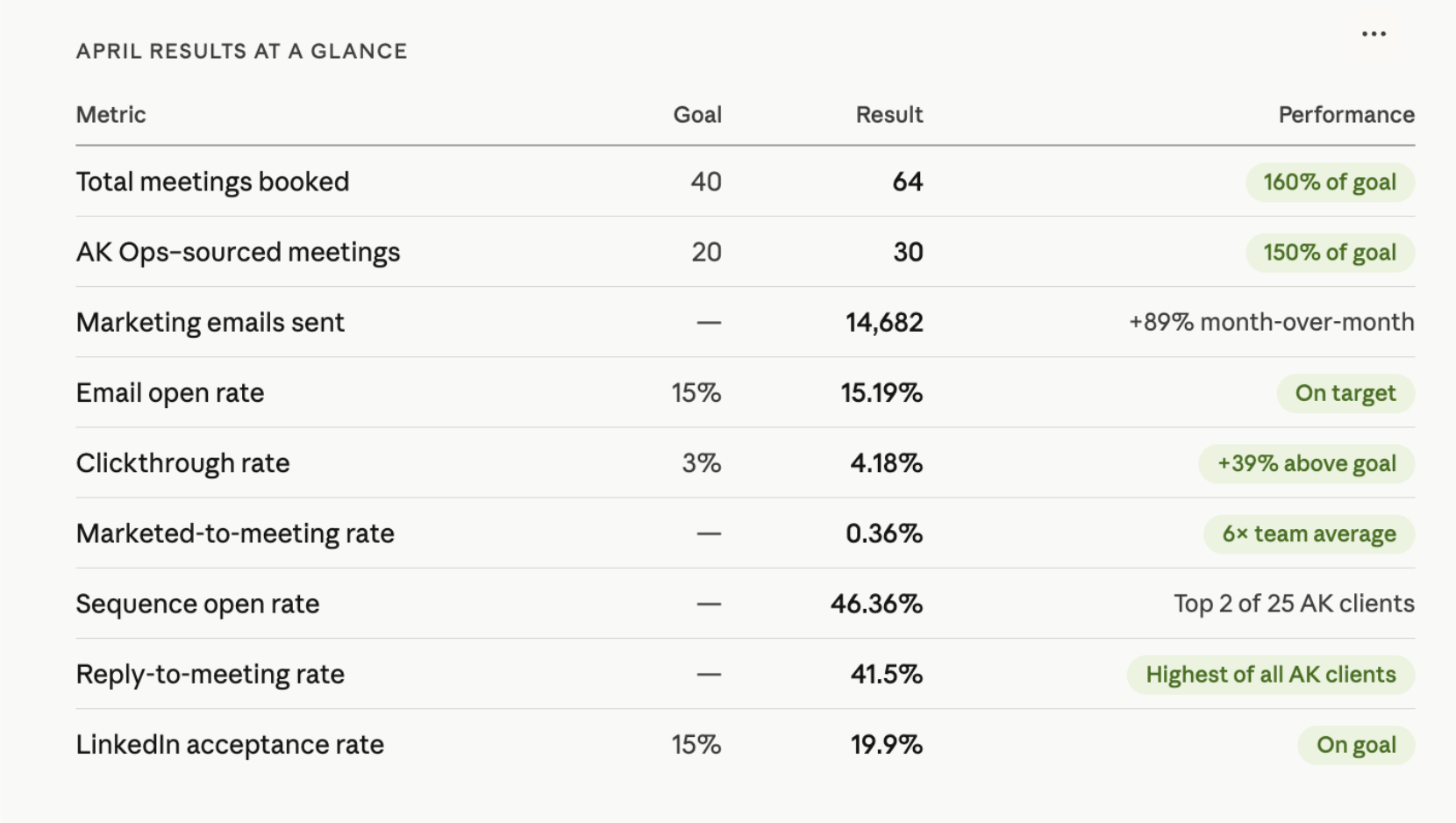
They came to AK Operations with a goal: 40 meetings a month. Thanks to their collaboration and Sara’s skills, we booked 64 in April!
The Approach: Precision Over Volume
Rather than blasting a single campaign to the entire database, AK Operations built a micro-campaign architecture, targeted sequences by segment, channel, and buyer stage, running on a disciplined 10-day email cadence with no more than 3 touches per contact per month.
Every campaign had a specific audience: direct prospects, appointed agents, BRP partners, close-lost retries, sports complexes, new agents, and more. Each ran on its own timing, messaging, and activation trigger.
The result was a pipeline that felt personal at scale.
What Drove the Results
1. Segmented Sequences That Actually Convert
The sequence strategy moved beyond generic outreach. Each contact segment (direct prospects, agents, BRP, close-lost, sports complexes) received messaging tuned to their context and timing.
The outcome: a 46% sequence open rate (vs. the AK team average of 29.1%), and a 41.5% reply-to-meeting rate, the highest of any AK Operations client and nearly 2x the team average of 23.7%.
When prospects replied, vQuip’s team closed them into meetings at a rate no other client matched.
2. The Close-Lost Retry Machine
One of April’s standout wins was the reactivation of a close-lost retry campaign, a 90–180 day automated sequence designed to re-engage prospects who had gone cold. Within 24 hours of launch, the campaign had enrolled contacts and booked its first meeting.
This campaign runs on a continuous cycle, ensuring no prospect permanently slips through the cracks.
3. Marketing Email Volume, With Discipline
Email volume jumped 89% month-over-month, yet quality held. Open rates hit the 15% goal. Clickthrough reached 4.18% against a 3% benchmark. And the marketed-to-meeting conversion rate came in at 0.36%, six times the team average.
The 10-day cadence model kept contacts from being over-touched while maintaining consistent top-of-funnel activation.
4. LinkedIn Outbound Gaining Ground
A structured LinkedIn outreach effort produced 678 connection requests in April, with a 19.9% acceptance rate against a 15% goal. The channel is still early-stage, but the foundation is being built deliberately, with a target of 1,200 requests per month in May as the team scales.
The Micro-Campaign Architecture: What It Actually Took
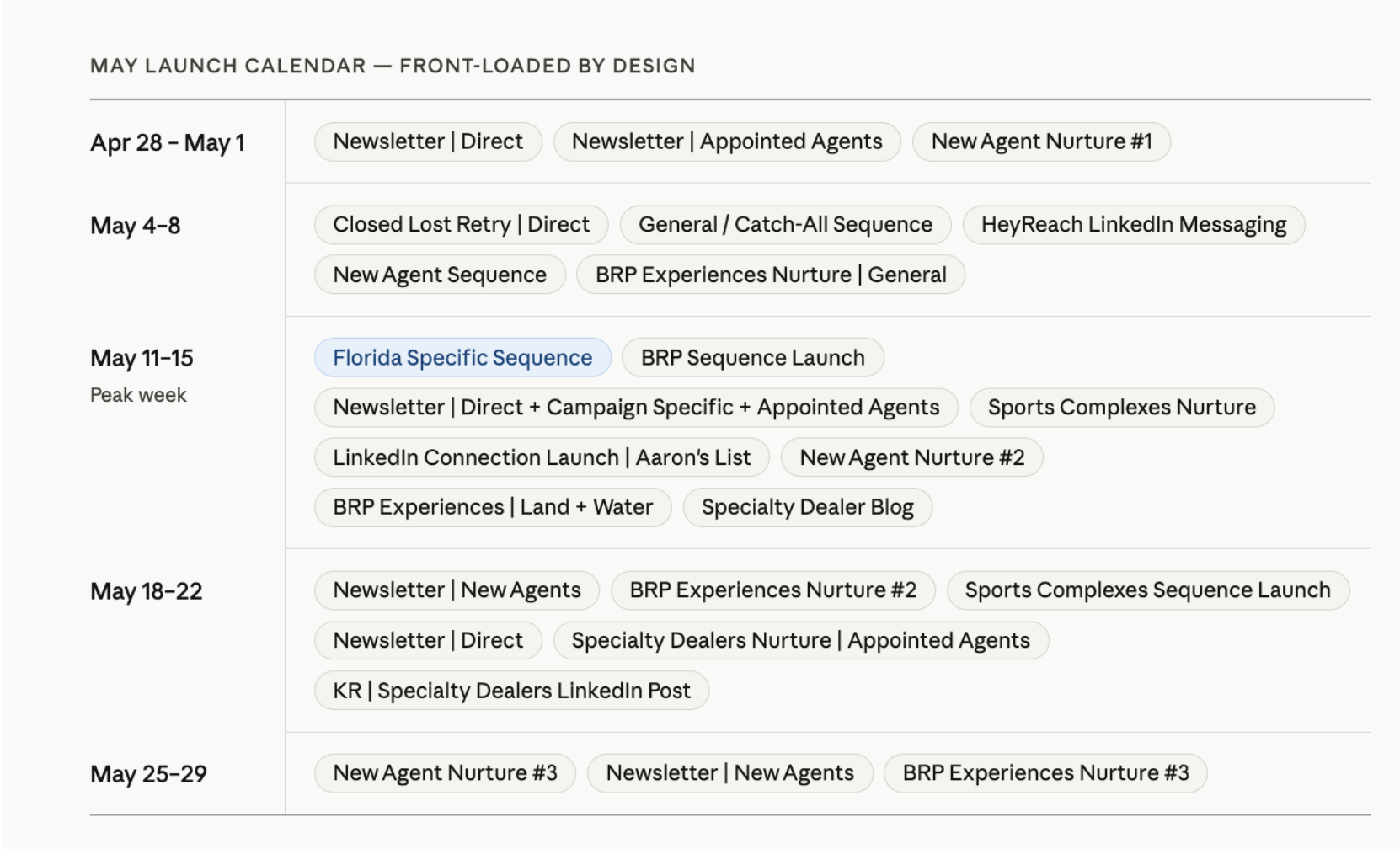
The micro-campaign model sounds simple in principle. In practice, it requires a level of planning discipline that most teams skip. Here’s what the campaign infrastructure behind vQuip’s April results actually looked like, and what was already queued for May before the month even started.
Every campaign in vQuip’s system is built around a single audience segment and a single objective. Nothing is sent to everyone. The active and in-progress campaigns running in and around April included:
The Rules That Keep It From Breaking
Running this many campaigns in parallel only works with strict operational guardrails:
- 10-day cadence, maximum 3 emails per contact per month: prevents list fatigue and preserves deliverability
- 30–45 day sequence messaging windows: avoids oversaturation within any single sequence
- Green/Black approval workflow: campaigns marked green are approved and live; black means pending review before launch. Nothing goes out unapproved.
- Source tracking on every meeting: inbound vs. channel vs. outbound is logged at the booking level, so the team always knows which campaigns are generating pipeline
- Rollover tracking: campaigns that started in a prior month (Powersports, Watersports, ATV) are explicitly flagged and managed separately from new monthly launches
This infrastructure is what separates a micro-campaign strategy from a messy multi-campaign nightmare. The discipline is the differentiator.
What Made This Work
Micro-campaigns, not macro-blasts. Each campaign was scoped to a specific audience with relevant messaging. No segment received a one-size-fits-all approach.
Front-loaded activation. The month was structured to get campaigns live early, giving sequences time to work through their full cadence before the month closed.
Source tracking and attribution. Meetings were tracked by origin, inbound, channel, outbound, giving the team clear visibility into what was driving pipeline and where to double down.
Continuous optimization. The close-lost retry campaign, LinkedIn expansion, and outbound calling improvements all reflect an iterative approach: launch, measure, refine, repeat.
May: Building on Momentum
April ended with 7 meetings already booked for May. The May calendar includes more than a dozen planned campaign launches, new agent nurture sequences, a Florida-specific campaign, sports complexes outreach, HeyReach LinkedIn messaging, and BRP experience nurtures by product line.
The goal is to repeat April: 40 meetings booked, 20,000 contacts activated in marketing, 3,000 activated in sales sequences.
The Takeaway
vQuip’s April performance wasn’t the result of a single big campaign. It was the compounding effect of multiple precision campaigns, each doing one job well, all running simultaneously.
For companies in niche B2B markets where relationships matter and segment context is everything, this micro-campaign model offers a repeatable, scalable path to pipeline, without sacrificing the quality that converts.
Interested in a pipeline strategy built for your market? Learn more about AK Operations.